

Night Guards & Bite Planes: Protect Your Teeth in St. John's
- 4 days ago
- 10 min read
Teeth grinding quietly destroys enamel while you sleep, and most people have no idea it is happening until a dentist finds the damage. Research published by the American Academy of Orofacial Pain estimates that bruxism affects roughly 8 to 10 percent of adults, and in many cases the first sign is a cracked filling or worn-down molar noticed at a routine checkup. If you are searching for a night guard dentist in St. John's, this guide explains exactly what your options are, how they work, and what Stavanger Dental does to make sure your appliance actually fits and protects you properly.
Table of Contents
Quick Takeaways
Key Insight
Explanation
Night guards protect enamel, not cure grinding
A night guard absorbs bite force and prevents surface wear, but it does not stop the muscular habit of grinding itself.
Bite planes address jaw position, not just teeth
A bite plane is designed to reposition the jaw and reduce TMJ stress, making it the right choice for patients with joint pain or an uneven bite.
Over-the-counter guards are rarely adequate
Boil-and-bite guards from pharmacies do not account for your specific occlusion and can actually worsen jaw misalignment over time.
Morning headaches are a diagnostic clue
Waking up with a dull headache, especially across the temples, is one of the most consistent signs of nighttime bruxism in clinical practice.
Bruxism is linked to sleep-disordered breathing
Studies show a significant overlap between bruxism and sleep apnea, so your dentist may ask about your sleep quality before prescribing an appliance.
Custom appliances typically last 3 to 5 years
With proper care, a professionally made hard acrylic night guard will outlast any pharmacy alternative and protect a much larger dental investment.
Stavanger Dental accepts the Canadian Dental Care Plan
Patients in St. John's covered under the CDCP may be eligible for partial coverage of protective appliances depending on their plan details.
What Is Bruxism and Why Does It Matter
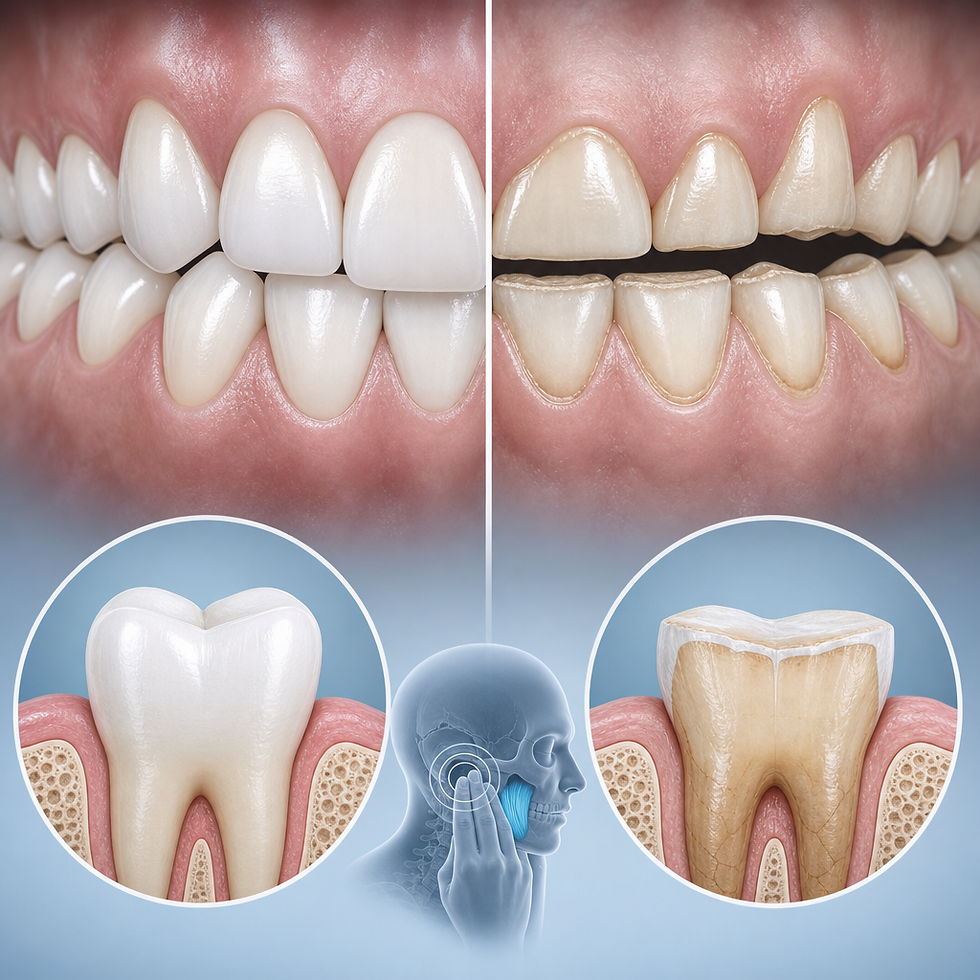
Bruxism is the involuntary clenching or grinding of teeth, most commonly during sleep. It is classified as a sleep-related movement disorder, which is why many patients are genuinely surprised when a dentist raises it. You cannot feel yourself doing it, but the consequences accumulate over months and years into fractures, worn enamel, loose fillings, and chronic jaw pain.
The forces generated during sleep bruxism are extraordinary. Resting bite force in a relaxed adult is typically around 20 to 40 pounds per square inch. During a grinding episode, that same jaw can produce forces exceeding 250 pounds per square inch, according to research published in the Journal of Oral Rehabilitation. That is enough to crack a molar in a single night under the right conditions.
In practice, patients often arrive at Stavanger Dental after years of unexplained tooth sensitivity, repeated crown failures, or persistent jaw soreness. By the time the pattern becomes obvious, significant damage has often already occurred. Early intervention with a proper appliance is not optional for heavy grinders. It is the difference between protecting your teeth and spending thousands of dollars replacing them.

Night Guards vs. Bite Planes: What Is the Difference
These two appliances are often confused, and some dental offices use the terms interchangeably, which creates real confusion for patients. They are not the same device, and they are not prescribed for the same reasons.
Night Guards: Physical Barrier Against Wear
A night guard is a rigid or semi-rigid acrylic appliance that sits over either the upper or lower teeth. Its primary function is protective: it creates a hard surface between your upper and lower arches so that grinding wears down the appliance rather than your enamel. It does not change how your jaw sits or how your teeth come together.
Night guards are the right starting point for patients whose main problem is enamel wear and whose jaw joints are functioning normally. They are effective, durable, and relatively straightforward to fabricate from dental impressions or digital scans.
Bite Planes: Repositioning the Jaw
A bite plane (also called an occlusal splint or Michigan splint) is a more targeted appliance. It is designed to place the jaw in a specific, therapeutically correct position, typically one that decompresses the temporomandibular joint (TMJ). It contacts only a subset of teeth, allowing the rest to passively rest without contact.
Bite planes are the preferred option when a patient presents with TMJ pain, clicking or popping of the jaw, limited mouth opening, or a diagnosed occlusal discrepancy. In Newfoundland, where access to TMJ specialists can involve a significant wait, having a dentist who understands bite plane therapy is genuinely valuable. Stavanger Dental prescribes bite planes as part of a broader TMJ management strategy, not in isolation.
Signs You Need a Night Guard or Bite Plane
The clearest signs are often found during a routine dental exam rather than reported by the patient. Flattened cusp tips, chipped anterior teeth with no trauma history, notching at the gumline (abfraction lesions), and craze lines in enamel are all visible evidence of parafunction. Your dentist at Stavanger Dental checks for these signs at every preventive visit.
Symptoms that patients do notice include jaw stiffness in the morning, a tired or sore feeling in the jaw muscles after waking, chronic headaches focused at the temples, and tooth sensitivity that has no obvious cavity-based explanation. Partners or family members noticing a grinding noise at night is also a reliable indicator.
"The most common mistake patients make is waiting until they have pain before seeking treatment. By then, enamel loss is irreversible. Enamel does not grow back." - General clinical guidance consistent with positions held by the Canadian Dental Association on bruxism management.
Children can also develop bruxism, and parents sometimes hear it clearly. Pediatric grinding usually resolves as the primary teeth are replaced, but it should still be evaluated. If you have a child grinding their teeth, mention it at their next appointment at Stavanger Dental so the team can monitor their occlusal development appropriately.
Pro tip: Take a photo of your teeth from the front with good lighting every six months. Comparing photos over two to three years can reveal gradual incisal edge wear that is invisible day to day but becomes obvious in a side-by-side comparison.
How Night Guards Are Made at Stavanger Dental
A professionally made night guard from a dental office is a completely different product from anything sold at a pharmacy. The process at Stavanger Dental starts with a thorough bite assessment to determine whether a standard night guard or a bite plane is the appropriate recommendation. This step is often skipped at offices that simply hand out appliances without evaluating jaw function.
Impressions or digital scans of both arches are taken to capture the exact geometry of your teeth. These records are sent to a dental laboratory where a technician fabricates the appliance from hard acrylic to precise specifications. The dentist checks the fit and bite at a delivery appointment, making adjustments to ensure the appliance seats correctly and that your bite closes evenly across it. An appliance that creates a premature contact on one side can cause more jaw problems than it solves.
Hard Acrylic vs. Soft Night Guards
Hard acrylic is the clinical standard for bruxism appliances. Soft guards, which feel more comfortable initially, can actually stimulate more grinding in some patients because the cushioning sensation triggers additional clenching activity. The data consistently shows that hard acrylic appliances outperform soft ones for heavy grinders over any period longer than a few months.
Soft guards are sometimes appropriate for mild clenchers or for children, but for an adult with documented enamel wear, a hard acrylic device is almost always the better recommendation.

Comparison of Appliance Types
Understanding which appliance matches your specific situation helps you have a more informed conversation with your dentist. The table below compares the three main options most commonly discussed in Newfoundland dental practices.
Appliance Type
Best For
Key Limitations
Hard Acrylic Night Guard
Adults with enamel wear from grinding, no significant TMJ symptoms, normal jaw alignment
Does not address jaw position or TMJ compression; requires lab fabrication time of 1 to 2 weeks
Bite Plane (Occlusal Splint)
Patients with TMJ pain, jaw clicking, bite discrepancies, or headaches linked to jaw muscle tension
More complex fitting process; requires follow-up adjustments; higher initial cost than a standard guard
Over-the-Counter Boil-and-Bite Guard
Temporary protection in an emergency before a dental appointment; travel situations where the custom guard is lost
Imprecise fit, may shift bite over time, degrades quickly under heavy grinding, no therapeutic value for TMJ
Teeth Grinding Treatment Options Beyond the Appliance
A night guard or bite plane is the foundation of teeth grinding treatment, but it works best as part of a broader approach. Bruxism has multiple contributing factors, and addressing only the mechanical output while ignoring the inputs limits the long-term result.
Stress is the most commonly cited driver of adult bruxism. Cognitive behavioral techniques and structured relaxation practices have measurable effects on grinding severity in clinical studies. This does not mean a dentist becomes a therapist, but it does mean that patients who actively manage their stress load tend to wear through their appliances more slowly and report less jaw soreness over time.
Botulinum Toxin for Severe Clenching
For patients with severe masseter hypertrophy (visibly enlarged jaw muscles from chronic clenching) and inadequate relief from appliances alone, botulinum toxin injections into the masseter muscle reduce the force of clenching significantly. This is not a first-line treatment, but it is a well-supported option for refractory cases. Results typically last three to six months and can be combined with ongoing appliance use.
Addressing Sleep-Disordered Breathing
The connection between bite plane Newfoundland patients and sleep apnea is clinically important. A study published in the journal Sleep and Breathing found that bruxism was present in approximately 31 percent of patients diagnosed with obstructive sleep apnea. If your dentist at Stavanger Dental suspects a sleep breathing component based on your history and presentation, a referral for a sleep study may be recommended before or alongside appliance therapy.
Treating sleep apnea with a mandibular advancement device or CPAP can reduce bruxism frequency substantially in these patients. An appliance prescribed without investigating this connection may provide incomplete relief.
Pro tip: If you are waking up with jaw soreness but your night guard shows minimal wear after six months, tell your dentist. Minimal wear can indicate clenching without lateral movement, which a standard night guard handles differently than active grinding. A bite plane may be a better fit for your pattern.
Caring for Your Night Guard or Bite Plane
A custom appliance is an investment that typically ranges from several hundred dollars depending on complexity and coverage. Proper care extends its lifespan significantly and maintains the hygiene that keeps your gums healthy. The protocol is simple but often ignored.
Rinse the appliance with cold water immediately after removing it in the morning. Use a soft toothbrush with mild dish soap or a non-abrasive appliance cleaner to brush all surfaces. Never use toothpaste: it contains abrasives that scratch acrylic and create bacterial retention sites. Store the appliance dry in its vented case, not sealed in a plastic bag where moisture encourages bacterial growth.
When to Replace Your Appliance
A hard acrylic night guard typically lasts three to five years for moderate grinders, and sometimes longer for mild cases. Signs that replacement is overdue include visible perforations through the acrylic surface, a cracked or warped body, or a loosened fit caused by changes in your dentition. Bring your appliance to every dental checkup at Stavanger Dental so the team can assess its condition and your current bite relationship together.
A common mistake is continuing to wear a perforated guard because it still feels comfortable. Once acrylic is perforated, the teeth are making contact through the hole and the protective function is compromised in that area.
Frequently Asked Questions
How do I know if I need a night guard or a bite plane?
If your main problem is visible enamel wear or a grinding sound reported by a partner, and your jaw joint functions without pain or clicking, a night guard is usually the appropriate starting point. If you have morning jaw stiffness, TMJ clicking, headaches centered in the temples, or a bite that feels uneven, a bite plane evaluation is warranted. Your dentist at Stavanger Dental will assess both your teeth and your jaw function before recommending either appliance.
Can I use a night guard bought from a pharmacy instead of getting a custom one?
Pharmacy guards can provide minimal short-term protection, but they are not a substitute for a custom appliance. The fit is imprecise, which means bite forces are distributed unevenly. For heavy grinders, an ill-fitting guard can cause more jaw discomfort than no guard at all. A custom appliance fabricated from your dental impressions distributes force correctly and lasts significantly longer.
Does the Canadian Dental Care Plan cover night guards?
Coverage under the Canadian Dental Care Plan depends on your specific eligibility tier and the clinical diagnosis supporting the appliance prescription. Stavanger Dental accepts the CDCP and can review your coverage details during your appointment to determine what portion, if any, applies to a custom occlusal appliance.
How long does it take to get used to wearing a night guard?
Most patients adapt within one to two weeks. The first few nights may feel awkward, and some patients report increased salivation initially. This resolves quickly. If discomfort persists beyond two weeks or you notice your bite feeling different during the day after wearing the appliance at night, contact your dentist for an adjustment. A well-fitting appliance should not feel intrusive after the break-in period.
Is teeth grinding in children something to treat right away?
Pediatric bruxism is common and often resolves on its own as the primary teeth exfoliate and the permanent dentition erupts. Active treatment is not always necessary, but monitoring is important. If a child is grinding heavily enough to show noticeable wear on primary teeth or complains of jaw soreness, a dental assessment is warranted. Stavanger Dental sees patients of all ages and can track changes in a child's bite over time to determine if intervention is appropriate.
Will a night guard stop my headaches?
If your headaches are caused by nighttime muscle tension from grinding or clenching, a properly fitted night guard or bite plane can reduce their frequency and severity noticeably. This is one of the most consistent pieces of feedback dentists receive from patients who begin appliance therapy. However, headaches have many causes, and a night guard is not a universal solution. If headaches persist after several weeks of consistent appliance use, your dentist may recommend further evaluation.
Have you been told you grind your teeth, or have you tried a night guard before? Share your experience in the comments below, we read every one and it helps other patients in St. John's know what to expect.


Comments