

Dental Crowns vs. Veneers: Best Smile Restoration
- Aug 17
- 12 min read
You have a chipped front tooth, or maybe a molar that's been patched with a large filling for years. Your dentist mentions crowns. Someone at work just got veneers. Now you're sitting at home wondering whether these two restorations are interchangeable - or whether picking the wrong one means paying twice. The short answer: crowns and veneers solve fundamentally different problems, and confusing them is one of the most common and costly mistakes patients make. If you are exploring dental crowns in St. John's or considering veneers at Stavanger Dental, this guide will help you walk into your appointment with the right questions already answered.
Table of Contents
What Are Dental Crowns and When Do You Need One?
A dental crown is a custom-fitted cap that encases the entire surface of a tooth. Think of it as a full sleeve that protects what remains of a tooth after significant damage, decay, or root canal treatment. Crowns are available in several materials: porcelain-fused-to-metal (PFM), all-ceramic, zirconia, and traditional gold alloy. Each has a specific clinical use case.
Crowns become necessary when more than roughly half of the original tooth structure is compromised. A tooth with a fracture running through the cusp, a molar that has had a root canal and needs protection from chewing forces, or a tooth with a cavity so large that a filling cannot hold - these all require a crown, not a veneer. Veneers simply cannot provide the structural reinforcement a severely damaged tooth needs.
Crowns also play a central role in implant restorations and in anchoring dental bridges. At Stavanger Dental, crowns are part of a broader restorative approach that includes dental implants and bridges - meaning the crown is often one piece of a larger plan, not an isolated fix.
What Are Dental Veneers and Who Are They Actually For?
A veneer is a thin shell, typically about 1 millimeter thick, bonded only to the front surface of a tooth. The tooth underneath remains mostly intact. Veneers are a cosmetic solution first and foremost: they correct discoloration that does not respond to whitening, close minor gaps, reshape slightly uneven teeth, and mask chips that are more of an aesthetic concern than a structural one.
The key word is "cosmetic." If a tooth is fundamentally healthy and the problem is appearance, veneers are a well-suited option. If the tooth has active decay, a large existing filling, or insufficient natural enamel for the veneer to bond to, veneers are the wrong tool. Using a veneer on a compromised tooth does not fix the underlying problem - it hides it temporarily, and usually not for long.
Porcelain veneers are the most durable and natural-looking type. Composite resin veneers can be placed in a single visit and cost less, but they stain more easily and typically need replacement sooner. At Stavanger Dental, dental veneers are offered as part of a cosmetic treatment menu that also includes Invisalign and teeth whitening, allowing the team to recommend the most appropriate option based on what the patient actually needs.
Quick Takeaways
Key Insight
Explanation
Crowns cover the whole tooth; veneers cover only the front
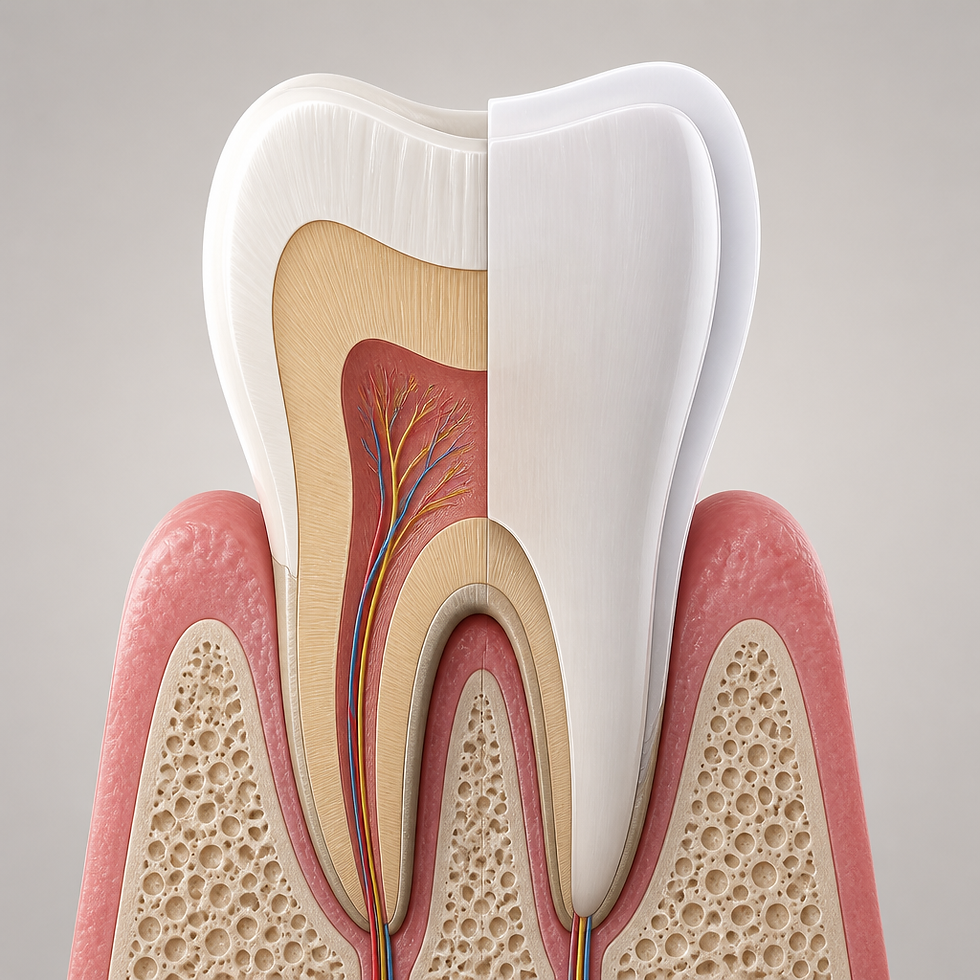
A crown encases all surfaces of the tooth. A veneer bonds only to the visible front surface, leaving the back and sides of the tooth exposed.
Structural damage calls for a crown, not a veneer
If a tooth has a large fracture, a significant cavity, or has undergone root canal treatment, a crown is the clinically appropriate choice. Veneers cannot restore structural strength.
Veneers preserve more natural tooth structure
Crown placement requires removing 1.5 to 2 mm of tooth structure on all sides. Veneers typically require removing less than 1 mm from the front surface only, which is a meaningful difference.
Both are permanent alterations to the tooth
Neither crowns nor traditional veneers are reversible procedures. Enamel is removed during preparation and cannot be restored. Patients should treat both as long-term commitments.
Insurance usually covers crowns but not veneers
Crowns are classified as restorative treatments and are commonly covered (at least partially) by dental insurance plans. Veneers are cosmetic and are almost never covered.
Bruxism is a serious risk factor for veneers
Patients who grind their teeth place excessive force on porcelain, which can crack or dislodge a veneer prematurely. A crown - or at minimum a custom night guard - is the safer approach.
Zirconia crowns outlast PFM on durability metrics
Zirconia offers significantly higher fracture resistance than porcelain-fused-to-metal. For back teeth that absorb heavy chewing forces, zirconia is generally the better material choice.
Before deciding between a crown and a veneer, it helps to understand the structural difference in plain terms. A crown rebuilds the whole tooth. A veneer improves the tooth's face. Those are genuinely different jobs, and a good treatment plan starts by identifying which job actually needs doing.

Crown vs. Veneer: The Honest Comparison
The table below compares the two restorations across the dimensions that matter most to patients making this decision. A third option, composite bonding, is included because it is frequently relevant for minor cosmetic cases and often overlooked.
Factor
Dental Crown
Porcelain Veneer
Coverage area
Entire tooth (all surfaces)
Front surface only
Primary purpose
Structural restoration and protection
Cosmetic improvement of appearance
Enamel removed
1.5 to 2 mm on all sides
Less than 1 mm from front surface
Best candidate
Cracked, decayed, post-root canal, or heavily filled teeth
Healthy teeth with cosmetic concerns (staining, chips, minor gaps)
Typical lifespan
10 to 15 years or longer
10 to 20 years depending on material and care
Insurance coverage
Often partially covered as a restorative procedure
Rarely covered; classified as cosmetic
Reversibility
Not reversible
Not reversible (traditional veneers)
One thing this table cannot capture is the judgment call a dentist makes during examination. In practice, a patient might think they need a veneer for a discoloured tooth, only for X-rays to reveal a cavity underneath the enamel that changes the entire plan. That is exactly why a thorough clinical examination, including digital X-rays, is the starting point at Stavanger Dental before any cosmetic treatment is recommended.
The right restoration is not the one that looks best in a before-and-after photo. It is the one that solves the actual clinical problem with the least irreversible alteration to the tooth.
Tooth Preparation and Enamel: What You Permanently Lose
This is the section most patients wish they had read before booking a cosmetic consult. Both crowns and traditional veneers require the dentist to remove natural tooth structure before the restoration can be placed. That removal is permanent. Enamel does not grow back.
How Much Enamel Is Removed for a Crown?
Crown preparation involves reshaping the tooth on all sides, reducing its diameter and height so the crown fits over it cleanly. This typically means removing 1.5 to 2 millimeters of tooth structure from every surface. For a tooth that is already significantly damaged, this trade-off makes complete sense - the tooth has already lost structural integrity and the crown restores it. For a relatively healthy tooth, however, that is a significant and irreversible alteration.
How Much Enamel Is Removed for a Veneer?
Traditional porcelain veneers require removing less than 1 millimeter from the front surface of the tooth. This is meaningfully less invasive than a crown. However, "less invasive" is not the same as "no impact." The enamel that is buffed away cannot be replaced, and if a veneer ever fails or needs to be replaced, the underlying tooth has already been permanently altered.
"No-prep" veneers exist as an option for a small subset of patients. These require little to no enamel removal. The trade-off is that they tend to look bulkier and may not be appropriate for everyone. A proper clinical assessment determines whether a patient's tooth dimensions and bite allow for no-prep treatment.
Pro tip: Ask your dentist specifically how much tooth structure will be removed and why. A good dentist will explain this clearly and factor it into their recommendation. If a crown is being suggested for a tooth that has no structural damage, ask whether a veneer or bonding would achieve the same result with less permanent alteration.

Lifespan, Durability, and What Breaks Them Down
Both restorations can last a long time when placed properly and maintained well. The factors that determine how long a crown or veneer lasts are, in order of importance: oral hygiene, bite forces and grinding habits, the quality of materials used, and how well the margins were sealed at placement.
How Long Do Crowns Last?
Most crowns last between 10 and 15 years with proper care, and many last significantly longer. Gold and zirconia tend to reach the top end of that range because of their high resistance to wear and fracture. PFM crowns are reliable but the porcelain layer can chip over time, especially on patients who grind their teeth.
Zirconia crowns have become a preferred material for many posterior (back) teeth because of their exceptional fracture resistance. For front teeth where translucency and natural color matching matter more, all-ceramic or lithium disilicate options tend to produce better aesthetic results.
How Long Do Veneers Last?
Porcelain veneers typically last between 10 and 20 years. Composite resin veneers, while less expensive upfront, are more prone to staining and generally need replacement within 5 to 7 years. The single biggest threat to veneer longevity is unmanaged bruxism. Nighttime grinding generates enough force to crack or dislodge porcelain. Patients who grind should either address that habit with a custom night guard or have an honest conversation with their dentist about whether veneers are a wise investment for their situation.
Pro tip: If you clench or grind at night and are considering veneers, ask about a custom-fitted night guard before committing to the veneer treatment. Protecting a porcelain restoration from grinding forces is not optional - it is the difference between a veneer lasting 15 years and lasting 3.
Cost and Insurance Coverage in Newfoundland
Dental restoration costs vary depending on the material selected, the complexity of the case, and the individual practice. For crowns, common material options include PFM, all-ceramic, and zirconia. For veneers, the main choice is between porcelain and composite resin. In general across North America, both crowns and porcelain veneers can range from several hundred to over two thousand dollars per tooth, depending on those variables.
The insurance picture is quite different between the two restorations. Crowns are generally classified as restorative procedures, meaning most dental insurance plans cover them at least partially. Veneers, by contrast, are almost universally classified as cosmetic and are typically excluded from coverage. If budget is a concern, this distinction matters significantly in treatment planning.
Stavanger Dental accepts the Canadian Dental Care Plan, which is a relevant consideration for eligible patients managing the cost of restorative treatment like crowns. For patients exploring cosmetic work like veneers, the team at Stavanger Dental can discuss financing options and help you understand the full scope of costs before treatment begins.
Who Is Not a Candidate for Veneers?
This question is asked far less often than "Am I a candidate for veneers?" - but it is arguably more important. Not every patient who wants veneers should have them. Placing veneers on the wrong patient leads to premature failure, additional expense, and in some cases, accelerated damage to the natural tooth.
Active Gum Disease or Untreated Decay
Veneers cannot be placed on teeth with untreated cavities or in a mouth with active gum disease. Bonding a veneer over decay traps the bacteria beneath the restoration, where it continues to damage the tooth structure. Any active disease must be treated and resolved before cosmetic work is considered.
Insufficient Natural Enamel
Veneers bond to tooth enamel. Patients with significantly eroded enamel due to acid reflux, a history of bulimia, or aggressive brushing may not have enough enamel for the veneer to bond reliably. In these cases, a crown is often the more appropriate restoration because it does not depend on enamel for bonding.
Unmanaged Bruxism
Patients who grind their teeth without any form of management are not good candidates for veneers. The repeated pressure fractures porcelain. A crown made from zirconia is far more resistant to grinding forces and may be a better choice for patients who cannot eliminate their grinding habit.
Severe Bite Misalignment
Significant bite problems should be corrected orthodontically before any cosmetic restoration is placed. At Stavanger Dental, Invisalign and orthodontic services are available to address bite issues before transitioning to cosmetic treatment, which is a sensible sequencing that protects the long-term result.
Smile Restoration at Stavanger Dental in St. John's
Stavanger Dental is a full-service family dental office in St. John's offering both dental crowns and dental veneers in NL as part of a comprehensive treatment menu. The practice uses digital X-rays and iTero digital scanning technology, which allows for more accurate tooth preparation and a better-fitting final restoration compared to traditional impression methods.
What makes the difference in smile restoration is not choosing between crowns and veneers in the abstract - it is a proper clinical examination that determines which option is genuinely appropriate for a given tooth and a given patient. The team at Stavanger Dental takes the time to walk patients through their options, explain the trade-offs, and build a treatment plan that addresses both function and aesthetics. For patients with more complex needs, the practice also offers sedation options, which makes longer restorative appointments more manageable.
If you have been sitting on the fence about a chipped tooth, a discoloured smile, or a molar that needs attention, the right move is to book an examination and get a clear picture of what is actually going on. Stavanger Dental is currently accepting new patients and can also accommodate emergency appointments for acute dental concerns.
Frequently Asked Questions
Can I get a veneer instead of a crown to save more of my tooth?
In some cases, yes. If the tooth has only minor cosmetic damage and is structurally sound, a veneer is a less invasive option that preserves more natural enamel. However, if the tooth has significant decay, a large filling, a fracture, or has had a root canal, a veneer does not provide the structural protection the tooth needs. A crown is the appropriate choice in those situations, and choosing a veneer instead would be a short-term fix that typically fails.
Are dental crowns covered by insurance in Newfoundland?
Crowns are generally classified as restorative procedures, so most dental insurance plans cover them at least partially, depending on the specific plan and the clinical necessity of the treatment. Stavanger Dental accepts the Canadian Dental Care Plan, which may provide coverage for eligible patients. Veneers are almost always classified as cosmetic and are not typically covered by insurance. Ask the front desk team at Stavanger Dental to help you understand your specific coverage before committing to a treatment plan.
How do I know if my tooth needs a crown or just a filling?
A filling is appropriate when decay or damage is limited to a small area and the remaining tooth structure is strong enough to support it. A crown becomes necessary when the damage is extensive, when an existing filling is so large that little natural tooth remains around it, or when the tooth has cracked. In practice, if a filling would cover more than roughly half the biting surface of a tooth, a crown is typically the stronger long-term solution. Your dentist will assess this with X-rays and a clinical examination.
How long does it take to get a dental crown at Stavanger Dental?
Crown placement typically requires two appointments. At the first appointment, the tooth is prepared, impressions or digital scans are taken, and a temporary crown is placed. At the second appointment, the permanent crown is bonded into place. The time between appointments depends on how quickly the lab fabricates the restoration. Stavanger Dental uses iTero digital scanning, which can improve the accuracy of the final fitting.
Do veneers look natural?
Well-made porcelain veneers are designed to match the translucency and color of natural tooth enamel, and in the hands of an experienced dentist, the results are indistinguishable from natural teeth. The quality of the outcome depends on the material chosen, the skill of the dental lab, and how carefully the shade and shape were planned during the consultation. Composite veneers can also look very natural immediately after placement but are more prone to staining and surface wear over time.
Can veneers fix crooked teeth without braces?
Veneers can mask mild irregularities in tooth shape and create the appearance of a more even smile. However, they cannot correct actual tooth misalignment or bite problems. For significant crowding or spacing issues, orthodontic treatment with Invisalign or traditional braces is the appropriate first step. Placing veneers on teeth with an uncorrected bite can lead to uneven pressure on the porcelain, increasing the risk of fracture or premature failure.
What happens when a crown or veneer needs to be replaced?
Both crowns and veneers can be replaced when they wear out, chip, or fail. Because the underlying tooth has already been prepared during the original procedure, replacement typically involves a similar process to the original placement. The tooth cannot be "un-prepped," which is why both restorations are considered permanent alterations. With proper care, crowns and porcelain veneers can last well over a decade before replacement is needed, and regular dental checkups help catch any issues early before they become more complex problems.
Have you had a crown or veneers placed, or are you currently weighing your options? Share your experience or questions in the comments - we would love to hear what helped you make your decision.
References
Healthline overview of the clinical differences between dental veneers and crowns
Which patients are not good candidates for porcelain veneers and what dentists recommend instead
Complete guide to porcelain veneer costs across North America including Canadian pricing context
Types of dental crowns, material options, longevity, and cost breakdown for 2025


Comments